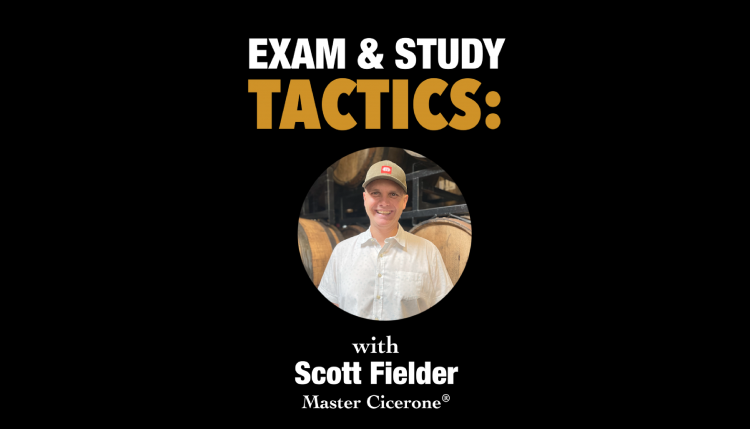
Exam and Study Tactics with Master Cicerone® Scott Fielder
Scott Fielder is the 29th person to pass the Master Cicerone® Exam. We sat down with Scott to talk about the experience, the study grind, and what he learned along the way.
Now that you’ve had some time to reflect, how does it feel? What does it mean to you?
Honestly, I don’t think I’ve touched the ground yet. We’re coming up on two weeks, and it hasn’t worn off. From what some of the other Master Cicerones have told me, it doesn’t really change anytime soon.
It means a lot for many reasons. I’ve documented my Cicerone journey since I started studying for the Certified exam. At that point, I didn’t have aspirations for Master. I just kept deciding to go for the next level, one step at a time, and eventually here we are.
Even though it’s technically the culmination of the program, it feels more like the end of a chapter than the end of the book. There’s a lot more to come. I already have some exciting projects in the works with my friend Chris Crowe, who’s an Advanced Cicerone®, and we’re hoping to launch something in about a month.
One thing I’ve told people is that while you’re waiting for exam results, it feels like the pause button is on your life. You’re holding space for what the next year might look like. When you get the phone call, it’s like someone hits unpause and everything moves forward at once. I was fully prepared to lock in and take it again if I didn’t pass, so having that moment of release was huge.
When you look back on the journey, what kept you moving forward when progress felt slow?
This one’s simple. It was Chris Crowe.
Having the privilege to study with someone who lived 25 minutes away and was just as dedicated as I was made all the difference. It’s hard to overstate how valuable that was.
We always reminded each other that this is a process. It’s more like sculpting or whittling than cramming. You can’t rush it. You can’t taste all the beers you need to taste or read all the material you need to read and immediately commit it to memory. It takes time and repetition.
We always had one or two days a week locked in to meet, either virtually or in person, to taste and study. Knowing those sessions were non-negotiable made it feel like progress was always happening, even on the tough days. That structure kept me from stalling out completely.
How did you structure your time around studying while balancing the rest of life?
The biggest thing for me was prioritizing quality over quantity.
With an exam like this, it’s easy to think you need to study five to seven hours a day or spend entire weekends buried in material. But after two or three hours, the quality just isn’t there anymore.
I focused on making the two hours I usually had each day extremely intentional. Sometimes it was three hours, depending on the day, but it was always dedicated and planned. That meant building a schedule, preparing for study sessions in advance, and making sure that when I was studying with someone else, I showed up ready.
I still had to dedicate a lot of time, and I was incredibly fortunate to have a supportive family. My spouse was my biggest supporter. I truly couldn’t have done this without her. She’s been my proctor since Certified, pouring countless blind tastings, helping with pairing exercises, and asking me questions constantly.
When I found out I passed, one of the first things I said to her was, “We did this.” That’s the truth.
I’ve always been someone who does things all-in or not at all, so this level of commitment wasn’t surprising to people who know me. But after taking the exam twice, I completely understand why some people attempt it two or three times and then step away. Balancing the rest of life is hard, and sticking to a schedule is non-negotiable.
For my first attempt, I woke up 45 minutes early every day before work just to practice a style essay. I did it as often as I possibly could.
The journey itself is the part I’m going to miss the most. I recently closed my flashcard app for the first time in two and a half years, and it felt strange knowing I didn’t have to open it again. That said, I’m excited to help anyone who wants to take this on. I hope I can be a resource moving forward.
Were there any beer styles you discovered or grew to appreciate more?
Doppelbock was a big one for us.
It’s known as one of the more difficult tasting panels on the exam, so it wasn’t always in weekly rotation, but there was a stretch where we kept giving it to each other. After tasting, we’d keep all the leftover samples and pair them with meats, cheeses, and different foods. Over time, we realized we kept reaching for the Doppelbock.
There are dark versions, lighter versions, and so much nuance. That eventually turned into a running joke of “drink more Doppelbock.” We even made t-shirts. At one point we were laughing about how you can just walk into Total Wine, buy Doppelbock, drink it, and nobody stops you.
The other big discovery for me was Baltic Porter, specifically Zywiec Baltic Porter. I didn’t have much familiarity with the style before starting my Cicerone journey. For the price point, the flavor, and the packaging format, it’s an incredible value. Zywiec is just undefeated in that regard.
Those two styles really stand out for me.
What was the strangest or most unconventional study technique you used?
One challenge at the Master level is the sheer number of off-flavors you’re expected to know. Some are naturally harder to perceive, and some people are partially anosmic to certain compounds.
One off-flavor we struggled with early on was 2-acetylpyridine, or 2AP. We learned it can be more perceptible in higher pH environments, so we tried finding the highest pH bottled water we could find before tasting the spiked sample. The idea was to see if that helped us perceive it more clearly.
It didn’t really work. Adjusting your body’s pH is far more difficult than just drinking alkaline water. But the process helped us land on solid descriptors and wrap our heads around it.
The most creative technique I used was for draft system balancing. I really struggled with the algebra involved and didn’t feel confident enough to write my own practice problems.
Eventually, I decided to teach ChatGPT how to do it. I uploaded information from the draft quality manual and walked it through the process. It was surprisingly helpful because I started catching its mistakes, which forced me to understand the math better.
It wasn’t perfect, and I still had to tweak questions, but it gave me something to teach. That alone made it useful. That said, ChatGPT still isn’t worthy of wiping the mud off Master Cicerone® Neil Witte’s boots when it comes to draft system expertise. He’s the GOAT.
What do people tend to underestimate or overestimate about preparing for the exam?
People underestimate how important the basics are.
As you move through the lower levels, it’s easy to label certain topics as “simple” and assume they won’t show up at the Master level. But if it’s on the syllabus, it’s fair game.
Nothing is simple at the depth this exam requires. Something that seems straightforward on the surface can go very deep when you’re expected to understand every mechanism, purpose, and implication.
What people overestimate is how much they can ignore weak areas and make up for them elsewhere. That mindset is a recipe for disaster. The syllabus is massive. You can’t really suck at anything.
If you skip subjects, they will find you on the exam. Every time.
What advice would you give someone preparing for the Master Cicerone® exam for the first time?
Practice oral exams early and often. Writing something confidently is very different from explaining it out loud, especially across a table from experts. The jump from two oral exams at Advanced to twelve at Master is massive.
If you’re even considering taking the exam, start gathering information early. Start building flashcards. That alone can take months. Don’t wait until you’re officially locked in.
There’s also a lot of pressure to “just take it” because most people don’t pass on the first attempt. That’s not universally true. I waited 18 months before my first attempt, and I’m very glad I did.
Start with styles. You can’t study them enough, and they branch into every knowledge area. One style can lead you into ingredients, process, off-flavors, draft systems, service, and food pairing. It’s the most efficient way to study holistically.
Don’t be afraid to ask for help or opportunities. We reached out to a malt house and asked if we could work there for a couple days. They said yes. We ended up floor-malting grain that was later used in a Sierra Nevada beer. That experience was invaluable.
Study in a group if you can, but keep it focused. It can’t turn into happy hour. Accountability is huge. After my first attempt, I asked Chris if I could text him every day with what I studied. That small habit changed everything. It showed me I was doing more than I thought and kept me honest. Start with accountability from the beginning. We wish we had done that in year one.
Anything else you’d like to leave the audience with?
One of the most common questions I get after this is whether it was worth it. People always want to know what the return on investment is. For me, I don’t look at it as what someone else is going to offer me. I look at it as what I can now do. I’ve learned an enormous amount. The depth of understanding I’ve gained has changed how I think about beer, how I communicate, and what I’m capable of contributing to the industry. That, to me, is the real return. And with some of the projects we have coming up, having this certification matters. It carries weight.
Cicerone Certification Program

Founded in 2007, the Cicerone program conducts examinations of beer knowledge for certification at four levels. Thousands of people who work for breweries, beer wholesalers, restaurants, bars, liquor stores and grocery stores have completed one or more levels of the certification program in the past year. Doing so demonstrates knowledge of beer keeping and service, beer styles, flavors, brewing process and ingredients and beer and food pairing.